
Domiciliary Care vs Residential Care: Which Is Right for Your Loved One?
When a family member needs more support than you can provide alone, one of the biggest decisions you'll face is whether to choose domiciliary care (care delivered at home) or move them into a residential care home. Both options have genuine merits — but the right choice depends on the individual's needs, preferences, and circumstances.
This guide explains the key differences, the costs involved, and how to decide between the two, particularly for families across Liverpool, Warrington, Halton, and Runcorn.

What Is Domiciliary Care?
Domiciliary care, often simply called home care, is professional care delivered in a person's own home. A trained carer visits at agreed times (or stays for longer periods, including live-in care) to help with anything from personal hygiene and medication management through to companionship and complex clinical needs.
Domiciliary care can be:
Short visits — typically 30 minutes to an hour, several times a day
Longer visits — for personal care, meal preparation, and social support
Overnight or live-in — for people who need round-the-clock support
Specialist — including palliative care, complex care, and mental health support
What Is Residential Care?
Residential care involves moving into a dedicated care home where staff are on-site 24 hours a day. Residents have their own bedroom but share communal living areas, mealtimes, and activities. Nursing homes go a step further, providing on-site qualified nurses for people with significant medical needs.
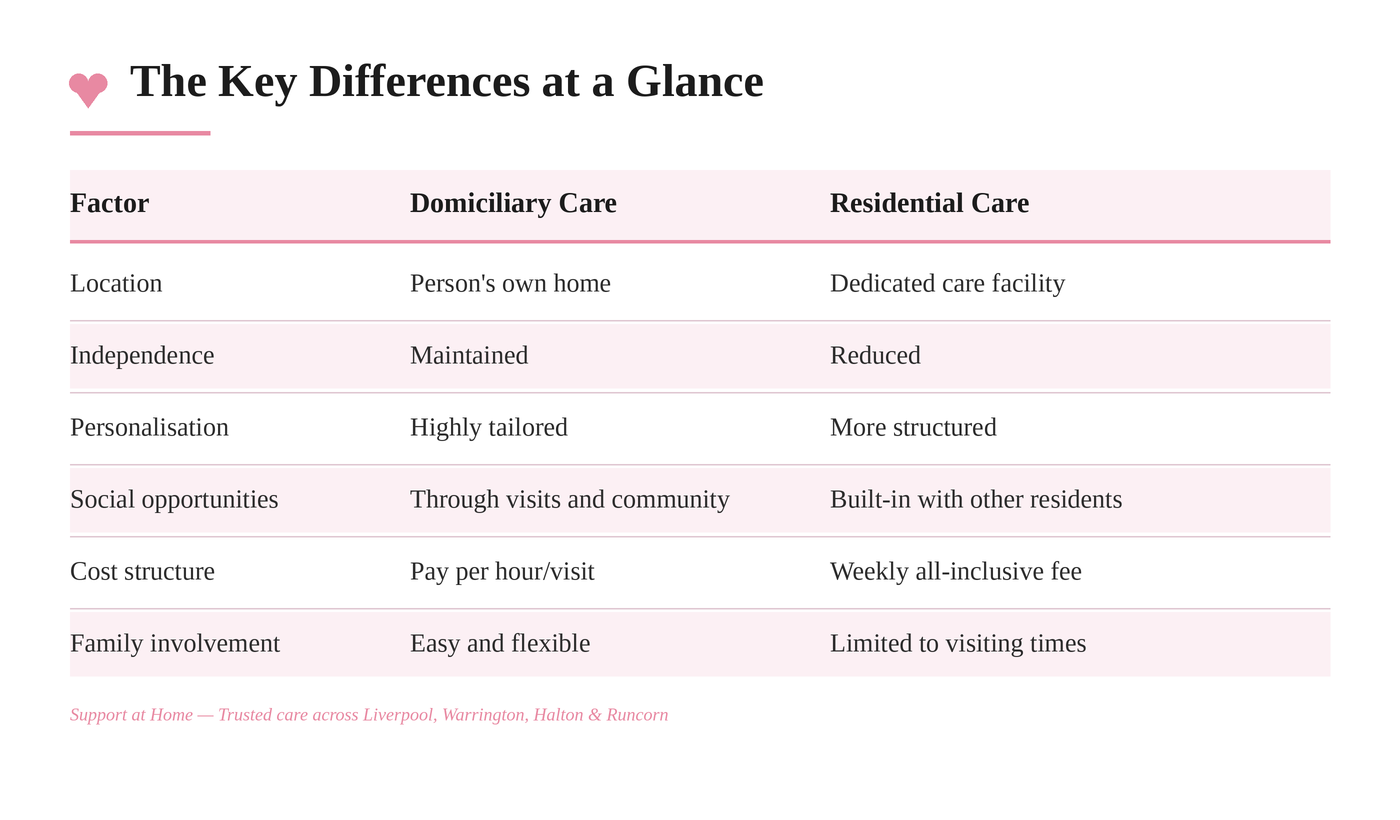
The Benefits of Domiciliary Care
1. Familiar surroundings. Home is where memories live. For people with dementia in particular, staying in a familiar environment can reduce confusion and distress.
2. Maintained independence. Domiciliary care supports people to keep doing the things they enjoy, cooking, gardening, seeing friends, walking the dog — rather than fitting around a care home's routine.
3. One-to-one attention. In residential care, staff are spread across many residents. At home, every minute of your carer's time is focused on you.
4. Family involvement. Loved ones can visit whenever they like, stay overnight, share meals, and remain genuinely involved in day-to-day life.
5. Tailored care plans. A good provider builds care around the individual, not the other way around. Our adult social care service is fully personalised from day one.
The Benefits of Residential Care
1. 24/7 staff presence. For people with high-level needs or those who cannot be left alone, the constant presence of trained staff offers reassurance.
2. Built-in social opportunities. Some people thrive on the company of other residents and the daily activities care homes provide.
3. All-inclusive cost. Bills, meals, utilities, and care are bundled into one weekly fee, which can simplify finances.
4. Suitable for severe needs. For people with advanced dementia or complex nursing needs, a well-run nursing home may be the safest option.
When Domiciliary Care Is Usually the Better Choice
Home care often works best when:
The person strongly values independence and familiar surroundings
Care needs are manageable with scheduled visits or live-in support
Family is local and able to be involved
The person is recovering from illness or surgery (our rehabilitation support is designed for exactly this)
The person has dementia and would be disorientated by a move
There are younger family members involved, see our children, young people & family support
When Residential Care May Be More Appropriate
Residential care can be a better fit when:
Care needs are extremely high and require constant supervision
The person lives alone, becomes very isolated, and would benefit from a community setting
Family cannot provide oversight, and home care visits aren't sufficient
The home is unsafe or unsuitable to adapt
Cost Comparison: What Should You Expect to Pay?
Costs vary significantly by region and level of need. In broad terms, residential care in the North West averages £900–£1,500 per week, while nursing care can exceed £1,500. Domiciliary care is typically charged hourly, making it more cost-effective for people who don't need round-the-clock support, though live-in care can be similar in cost to residential.
For a clear breakdown of how to pay for either option, including local authority and NHS funding routes, see our complete guide to funding your care.
How to Decide
Start by asking three questions:
What does your loved one want? Their wishes matter most.
What level of care is genuinely needed? Be honest about safety and clinical needs.
What's financially sustainable? Consider both short and long term.
A professional assessment, which we offer free of charge, can help bring clarity. We'll visit your home, talk through the options, and give you an honest view of whether home care is right for you.
Speak to Our Care Team
If you're weighing up your options, we're here to help. Get in touch with Support at Home or call 0151 486 8494 to arrange a free, no-obligation chat. You can also learn more about who we are and what makes our approach different.